Explainer
How rankings work
From web crawler to the top of the page, and what that journey means for voters.
Crawl, index, rank
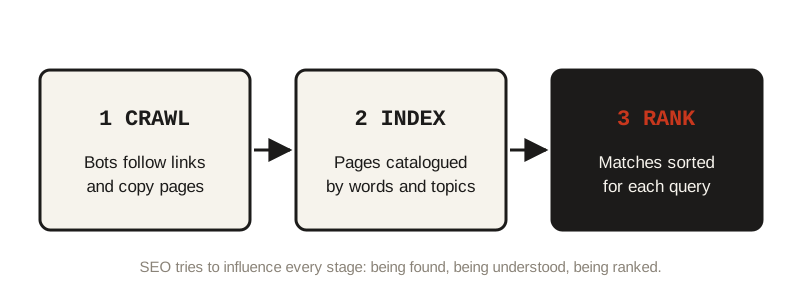
A search engine works in three stages. First, automated crawlers follow links across the web and download pages. Then those pages are stored in an index (a catalog of the words and topics they contain). When someone searches, ranking systems pull matching pages from the index and sort them in fractions of a second.
The sorting depends on many signals, such as how well a page matches the query, how many trusted sites link to it, how recently it was updated, and how well it works on a phone. Companies publish general guidance about these signals but hide the formulas (partly so they are harder to manipulate).
Can rankings move votes?
Psychologists Robert Epstein and Ronald Robertson tested it directly in a 2015 study. Undecided people researched real candidates using a mock search engine whose results were quietly biased towards one side. People who saw biased rankings changed their preferences towards the favored candidate (most didn’t notice the bias). They called this the search engine manipulation effect.
Lab experiments are not elections, and later audits of real search results have found less personalization on political queries than early fears of a “filter bubble” suggested. But the research shows why ranking should get the scrutiny we give editorial choices in print and broadcast news.